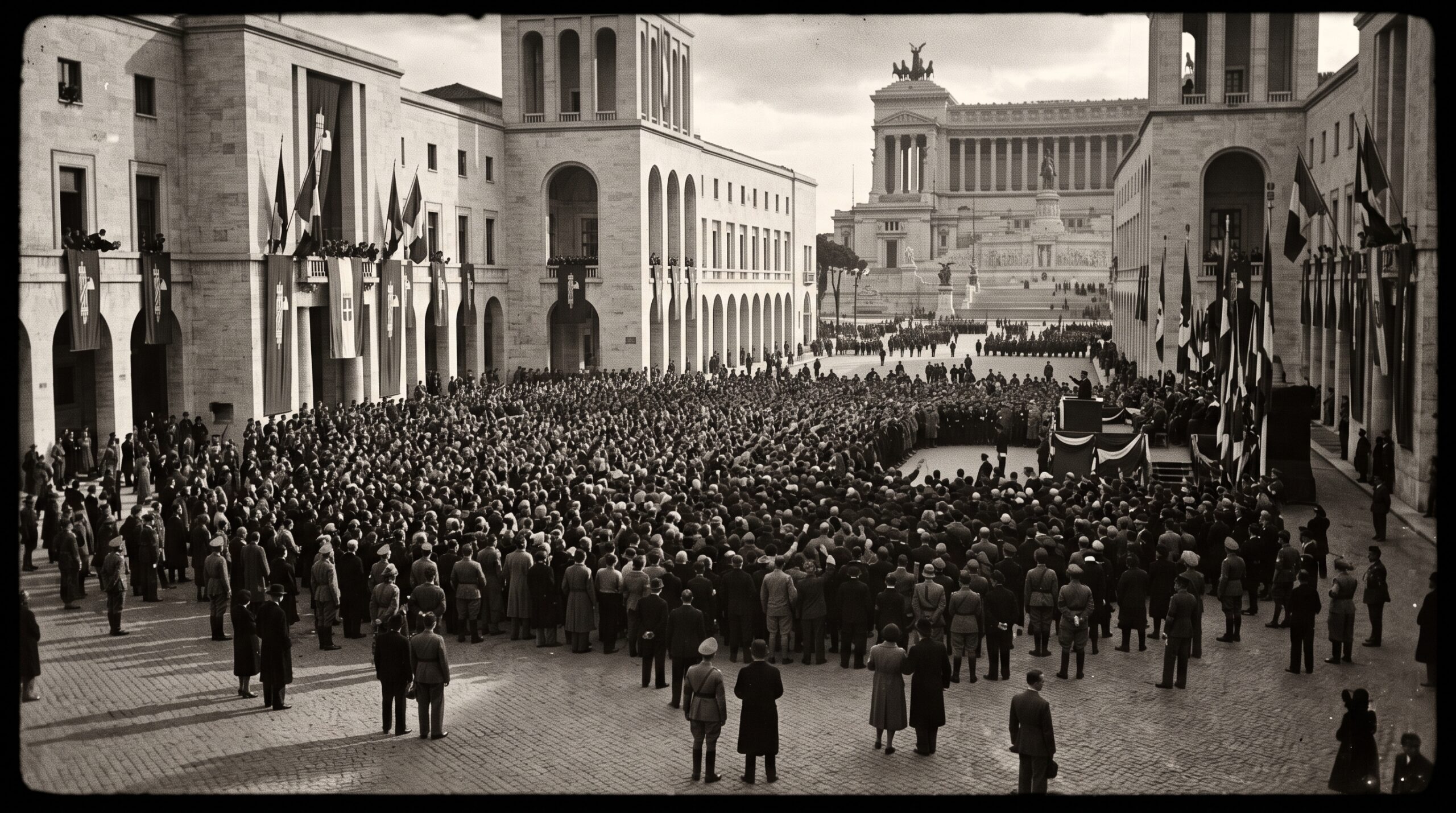
In the Danish language, a single word carries the weight of one of the 20th century’s darkest chapters: fascisterne “the fascists.” While the term may sound distant to many American readers, its story is deeply connected to events that shaped the modern world and directly involved the United States in the largest conflict in human history.
Why does fascisterne matter right now? Because the conditions that allowed fascism to emerge economic turmoil, political polarization, fear of upheaval, and charismatic leaders promising simple solutions have echoes in every era. Understanding exactly what fascisterne represented helps separate historical fact from rhetorical weaponization of the word “fascist” in today’s heated debates.
In this article, you will learn the true origins of the term, how Benito Mussolini transformed a small movement into a totalitarian regime, the ideology’s key pillars, Italy’s path into World War II, the human cost, and the concrete lessons this history holds for citizens of any democracy including our own.
Table of Contents
- The Meaning of Fascisterne: Etymology and Symbolism
- Post-World War I Italy: The Chaos That Birthed Fascism
- The March on Rome and the Rapid Seizure of Power
- Core Ideology of the Fascisterne: What Did They Actually Believe?
- Life Under Mussolini: Policies, Propaganda, and Daily Control
- Fascisterne at War: Italy’s Alliance with Nazi Germany and World War II
- The Fall of Il Duce and the Collapse of the Regime
- Why Understanding Fascisterne Still Matters for Americans Today
The Meaning of Fascisterne: Etymology and Symbolism
Fascisterne is the definite plural form in Danish (and similar in Norwegian and Swedish) for “the fascists” people who supported or belonged to fascist political movements. The word traces directly back to Italian fascismo, which itself comes from fascio (bundle) and ultimately the Latin fasces.
The fasces was an ancient Roman symbol: a bundle of wooden rods tied together with a red leather strap, often with a single-bladed axe protruding from the center. Roman lictors carried it before magistrates as a visible reminder of the state’s authority to punish the rods for beating, the axe for execution. The bundle represented strength through unity: individually weak sticks become unbreakable when bound together.
Benito Mussolini and his followers deliberately adopted this symbol in 1919. They saw themselves as reviving Roman imperial glory and used the fasces to signal that individual Italians must submit to the unified strength of the state under a single leader. The name “fascist” and the term fascisterne in Scandinavian languages both flow from this deliberate historical branding.
Post-World War I Italy: The Chaos That Birthed Fascism
Italy emerged from World War I on the winning side but felt deeply betrayed. The country suffered over 600,000 military deaths and massive economic strain, yet the 1919 Treaty of Versailles and related agreements delivered far less territory than Italian nationalists had been promised. This “mutilated victory” created widespread resentment.
At home, Italy faced strikes, factory occupations, rural unrest, and fears of a Bolshevik-style revolution similar to Russia’s 1917 upheaval. Inflation soared, unemployment spiked, and governments changed frequently in a fragile parliamentary system. Many middle-class and rural Italians craved order, national pride, and protection from leftist radicalism.
Benito Mussolini, born in 1883 to a socialist blacksmith father and a Catholic schoolteacher mother, began his career as a prominent socialist journalist and editor of Avanti!. He broke with the Socialist Party in 1914 over his support for Italy entering the war on the Allied side. By 1919, he had reinvented himself as a fiery nationalist.
On March 23, 1919, Mussolini founded the Fasci Italiani di Combattimento in Milan with only about 200 initial members. The early program mixed radical ideas (women’s suffrage, nationalization of some industries) with aggressive nationalism and anti-socialist violence. Squads of Blackshirts (squadristi) began attacking socialist and communist organizers, trade unionists, and newspapers. Violence became a political tool.
According to historical records, fascist membership grew rapidly amid the turmoil from a few hundred in 1919 to tens of thousands by 1921 as many Italians saw the movement as the only force capable of restoring stability.
The March on Rome and the Rapid Seizure of Power
The pivotal moment came in late October 1922. Mussolini organized the March on Rome, involving roughly 30,000 Blackshirts converging on the capital. The action was partly bluff and partly genuine threat of civil war.
Rather than declare martial law, King Victor Emmanuel III invited Mussolini to form a government. On October 31, 1922, the 39-year-old former socialist became Italy’s youngest prime minister at the head of a coalition cabinet.
Mussolini moved quickly to consolidate power. The 1923 Acerbo Law awarded two-thirds of parliamentary seats to the party with the largest share of votes (even if less than 50%). In the 1924 elections, held amid intimidation, the Fascists secured a dominant position. After the murder of socialist deputy Giacomo Matteotti in 1924, Mussolini used the crisis to eliminate remaining opposition.
By January 3, 1925, he openly declared his dictatorship in a speech to parliament. A series of laws in 1925–1926 dismantled democratic institutions, banned opposition parties, censored the press, and created the secret police organization OVRA. Mussolini became Il Duce the Leader with near-absolute power.
What began as a coalition government transformed into a one-party totalitarian state within roughly three years.
Core Ideology of the Fascisterne: What Did They Actually Believe?
Fascism was not simply extreme conservatism or generic authoritarianism. Historians identify several interlocking pillars:
- Ultranationalism and statism: The nation (embodied in the state) stood above all else. Mussolini’s famous formulation: “Everything within the state, nothing outside the state, nothing against the state.”
- Authoritarian leadership and cult of personality: Democracy was viewed as weak and decadent. A single strong leader embodied the national will.
- Rejection of both liberal democracy and Marxism: Fascists opposed class struggle and international socialism while also rejecting unfettered capitalism and individualism.
- Corporatism: The economy was organized into state-supervised “corporations” representing employers and workers in each industry. The goal was class collaboration under state direction rather than free markets or state ownership.
- Militarism and glorification of struggle: War and conflict were seen as purifying and necessary for national vitality. Youth organizations indoctrinated children with martial values.
- Anti-liberalism and anti-egalitarianism: Individual rights were subordinate to national duty. Fascism promoted hierarchy and a “new man” forged through discipline and loyalty.
The movement drew inspiration from ancient Rome, revolutionary syndicalism, and the trauma of World War I trench warfare. It promised national rebirth (risorgimento on steroids) after perceived humiliation and weakness.
Life Under Mussolini: Policies, Propaganda, and Daily Control
Daily life under the fascisterne blended genuine popular support with increasing repression. Early public works projects (roads, railways, draining marshes) and the Lateran Treaty of 1929 with the Vatican which created Vatican City and improved Church-state relations won broad approval.
Propaganda was relentless. Mussolini’s image appeared everywhere. The regime controlled radio, newspapers, and eventually radio broadcasts. Youth organizations like the Balilla indoctrinated children with fascist values. Opposition was silenced through censorship, secret police (OVRA), and occasional violence.
Economically, the regime promoted autarky (self-sufficiency) and corporatism state-mediated cooperation between workers and employers. Some infrastructure projects and public works gained popular support, but Italy remained poorer than many European neighbors, and living standards stagnated for many ordinary people.
By the late 1930s, Mussolini’s alliance with Hitler and adoption of racial laws (the 1938 Manifesto of Race) marked a darker turn, aligning Italy more closely with Nazi Germany’s ideology and policies.
The Fall of Il Duce and the Collapse of the Regime
Italy’s entry into World War II on June 10, 1940, proved disastrous. Italian forces performed poorly in Greece, North Africa, and on the Eastern Front. The alliance with Germany brought more defeats than victories.
By July 1943, after the Allied invasion of Sicily, Mussolini’s own Grand Council of Fascism voted against him. King Victor Emmanuel III dismissed and arrested him. Germany rescued Mussolini in a dramatic raid and installed him as head of a puppet state the Italian Social Republic (Salò Republic) in northern Italy.
The regime’s end came quickly. On April 27–28, 1945, as Allied forces advanced and partisan uprisings spread, Mussolini was captured near Lake Como while trying to flee to Switzerland with his mistress, Clara Petacci. Both were executed by Italian communist partisans the next day. Their bodies were taken to Milan and hung upside down in Piazzale Loreto for public display a grim mirror of earlier fascist violence.
The fascist era in Italy, which had begun with such promise of national renewal for many supporters, ended in military defeat, civil war, and national humiliation.
Why Understanding Fascisterne Still Matters for Americans Today
The word fascisterne Danish for “the fascists” is more than historical trivia. It reminds us that authoritarian movements often begin by exploiting real grievances: economic insecurity, national humiliation, fear of social change, and distrust of democratic institutions. They promise order, strength, and national rebirth under a single strong leader who claims to embody the people’s will.
The Italian case shows how quickly democratic norms can erode when institutions are weakened, when political violence is normalized, when independent media and courts are attacked, and when citizens grow willing to trade freedoms for the illusion of security and greatness.
For Americans, the lesson is not that “it could never happen here,” but that vigilance matters. Strong democratic institutions, peaceful transfer of power, protection of minority rights, free press, independent judiciary, and a citizenry that values facts over propaganda are not automatic they require active defense.
Studying fascisterne and the regime they built helps us recognize the early warning signs of authoritarian drift wherever they appear, without trivializing the term or applying it carelessly to every political disagreement. History’s value lies in helping us make better choices in the present.
FAQs
What does “fascisterne” literally mean?
It is the Danish definite plural form of “fascist,” meaning “the fascists.” It refers to supporters or members of fascist movements, most famously Benito Mussolini’s regime in Italy.
Who founded fascism and when?
Benito Mussolini founded the movement in Milan on March 23, 1919, as the Fasci Italiani di Combattimento. It became the National Fascist Party in 1921 and took power in Italy in 1922.
What is the difference between fascism and Nazism?
Fascism originated in Italy under Mussolini and emphasized ultranationalism, a strong state, corporatism, and dictatorial leadership. Nazism (National Socialism) in Germany added explicit biological racism, antisemitism, and the concept of Lebensraum. The two regimes allied closely but were not identical.
How did Mussolini rise to power so quickly?
Post-World War I Italy faced economic chaos, strikes, and fear of communism. Mussolini’s Blackshirts used violence against leftists while promising order and national revival. In October 1922, the March on Rome led King Victor Emmanuel III to appoint him prime minister. Within three years he had dismantled democracy.
Why did Italy perform so poorly in World War II?
Italy was less industrialized than Germany or Britain, its military was poorly equipped and led, and Mussolini made strategic errors (invading Greece in 1940 without adequate preparation). The alliance with Germany ultimately brought more harm than benefit.
Is the term “fascist” still used accurately today?
Historians generally reserve it for regimes and movements sharing core features of interwar Italian Fascism and German Nazism: revolutionary ultranationalism, dictatorial leadership, suppression of opposition, and regimentation of society. Casual modern usage often dilutes the term’s specific historical meaning.
What happened to Mussolini’s body and legacy after his death?
After execution, his body was displayed in Milan. It was later buried in a family crypt in Predappio. Neo-fascist groups have occasionally tried to rehabilitate aspects of the regime, but mainstream Italian society rejects fascism. Predappio remains a site of both historical tourism and occasional far-right gatherings.
What is the single most important lesson from the story of the fascisterne?
Authoritarian movements often gain initial support by promising to solve real problems through strong leadership and national unity. Once power is consolidated, however, they typically destroy the very democratic mechanisms that allowed them to rise. Protecting institutions, facts, and peaceful political competition remains essential in any democracy.