
Quick Answer
Startup Booted Financial Modeling is the practice of creating revenue-first financial projections and cash-flow frameworks for self-funded startups that rely primarily on founder capital, early customer revenue, and reinvested profits rather than external equity or debt. The five most effective strategies are: (1) driver-based bottom-up revenue forecasting grounded in validated customer data; (2) rolling 13-week cash-flow projections with explicit runway and burn-rate tracking; (3) rigorous unit-economics measurement and optimization (especially LTV:CAC and contribution margins); (4) lean, variable-heavy cost structures tied to clear break-even milestones; and (5) continuous scenario planning, stress testing, and monthly actual-versus-forecast reconciliation. When executed with discipline, these strategies convert financial modeling from a static spreadsheet exercise into a living management system that protects runway, reveals profitable growth paths, and supports informed decisions without diluting ownership.
What Exactly Is Startup Booted Financial Modeling?
Startup Booted Financial Modeling refers to the systematic process of forecasting a startup’s revenue, expenses, cash position, runway, and path to profitability while assuming the primary funding source is internal—customer payments, founder savings, and operating cash flow—rather than venture capital or significant outside investment.
The distinction matters. Traditional startup financial models often begin with an assumed funding round and work backward to justify aggressive growth and elevated burn rates. Booted models begin with current cash, near-term revenue visibility, and the hard constraint that negative cash flow cannot continue indefinitely without threatening survival. This produces more conservative assumptions, earlier focus on unit profitability, and explicit buffers for timing mismatches between cash inflows and outflows.
In practice, a robust booted model typically includes:
- A monthly or quarterly profit-and-loss projection built from the ground up.
- A cash-flow statement (or 13-week rolling cash forecast) that tracks actual liquidity.
- A simplified balance sheet or at least working-capital tracking.
- Supporting analyses: cohort retention, customer acquisition economics, break-even calculations, and scenario versions.
The goal is not perfect prediction impossible in early-stage businesses but clarity on the variables that actually determine survival and the ability to course-correct before cash runs out.
Core Components and How Startup Booted Financial Modeling Works
Effective models rest on three interconnected statements plus supporting driver logic. Revenue projections drive the income statement. The income statement and working-capital assumptions feed the cash-flow view. Cash positions and timing inform runway and contingency planning. All elements must remain dynamic so that changing one assumption (for example, a 15% rise in customer acquisition cost) instantly updates runway, break-even timing, and required reserves.
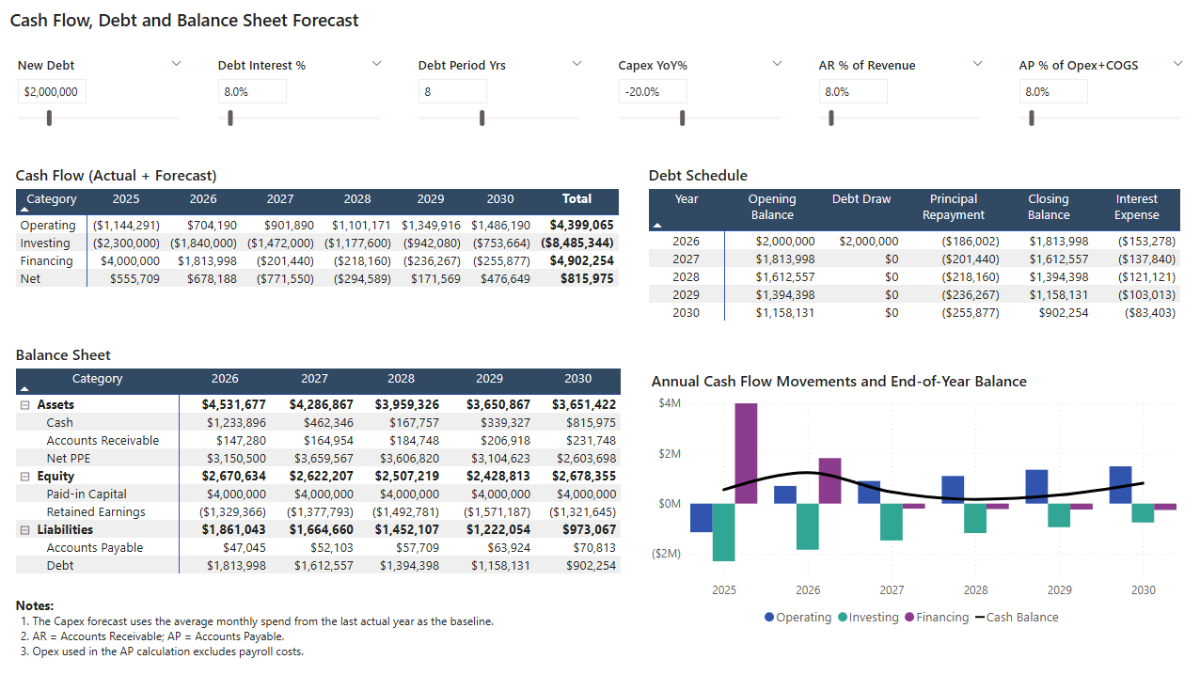
Key operational components include:
- Driver tabs or sections that isolate the handful of variables with the greatest leverage (conversion rates by channel, average revenue per customer, churn, variable cost percentages, collection timing).
- Explicit assumption documentation with source notes and confidence levels so the model can be audited and updated.
- Sensitivity or scenario layers that show best-case, base-case, and downside outcomes.
- Reconciliation routines that compare actual results to the prior forecast and force explicit updates to forward assumptions.
When these components function together, the model becomes a decision-support tool rather than a compliance exercise.
The 5 Best Strategies for Startup Booted Financial Modeling
Strategy 1: Adopt Driver-Based, Bottom-Up Revenue Forecasting
Top-down market-share assumptions (“we will capture 2% of a $5 billion TAM”) are common in pitch decks but dangerous for bootstrapped companies. Bottom-up modeling starts with observable, testable drivers: number of leads from each channel, conversion rates at each funnel stage, average order value or contract value, expansion revenue, and retention curves by cohort.
Implementation steps:
- Define 2–4 primary acquisition channels and validate current or pilot performance with real data (even 20–30 conversions provide a starting point).
- Build monthly cohort projections or use funnel formulas that link volume, conversion, and pricing.
- Apply realistic ramp curves for new channels and explicit churn or contraction rates.
- Create sensitivity tables showing revenue impact if key drivers move ±20%.
This approach surfaces problems early. A founder may discover that paid search looks attractive in isolation but destroys contribution margin once realistic close rates and support costs are modeled. The discipline also prevents over-hiring sales or marketing staff before the unit economics justify them.
Strategy 2: Implement Rolling 13-Week Cash-Flow Forecasts and Runway Tracking
Profitability on an accrual basis does not equal cash in the bank. Bootstrapped founders must manage timing explicitly. A 13-week rolling cash forecast provides the necessary granularity for payroll cycles, vendor payments, receivables collection, and tax obligations.
Core practices:
- Forecast cash inflows conservatively (apply historical or expected collection percentages to invoiced revenue).
- Categorize outflows by fixed versus variable and by timing (weekly, monthly, quarterly).
- Calculate and monitor average monthly burn and remaining runway in months.
- Maintain a minimum 4–6 month cash buffer as a non-negotiable policy, adjusting spending before the buffer is threatened.
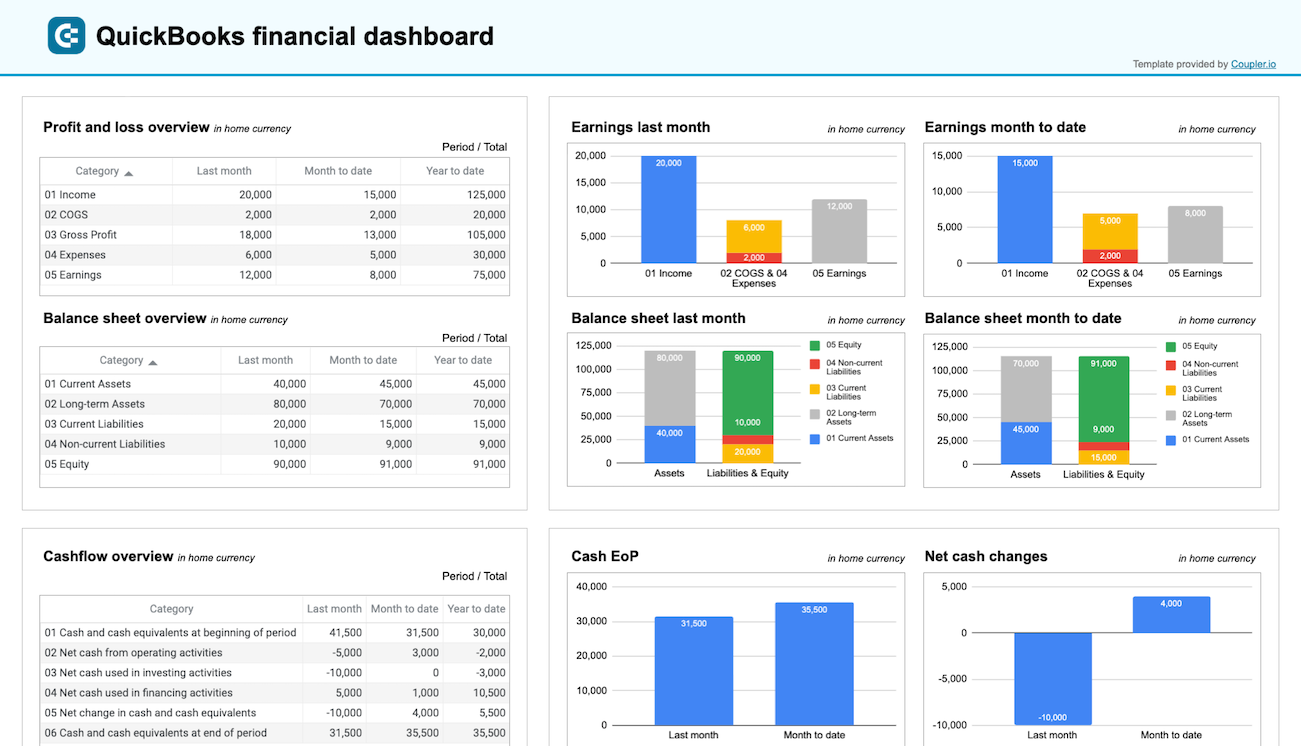
Many founders who fail do so not because revenue disappeared but because collections lagged or a large quarterly expense coincided with a slow month. The rolling forecast makes these collisions visible weeks or months in advance.
Strategy 3: Embed Unit Economics and Contribution Margin Tracking
Sustainable growth requires that each additional customer or unit contributes positively after variable costs. Track customer acquisition cost (CAC), lifetime value (LTV), payback period, and contribution margin (revenue minus variable costs) at the cohort or product level.
Target benchmarks commonly referenced for healthy bootstrapped businesses include an LTV:CAC ratio of at least 3:1 and payback periods under 12 months so that capital recycles quickly. Gross margins above 65–70% are often necessary to cover fixed costs and still generate reinvestable profit.
Practical actions:
- Build simple cohort tracking (even in a spreadsheet tab) that follows customers acquired in a given month over subsequent periods.
- Calculate contribution margin per customer or transaction and monitor trends.
- Use these metrics as go/no-go gates for new marketing spend or product features.
When unit economics are weak, growth itself becomes value-destructive. The model makes this visible before cash is exhausted.
Strategy 4: Design Lean, Variable-Heavy Cost Structures Anchored to Break-Even Milestones
Fixed costs (salaries, office leases, core software subscriptions) create ongoing cash obligations regardless of revenue. Bootstrapped models perform best when the cost base remains heavily variable until revenue reliably covers new fixed expenses for an extended period (commonly 6+ months).
Key tactics:
- Classify every expense as fixed or variable and challenge any new fixed commitment.
- Tie hiring to clear revenue thresholds: “We will add this role only after recurring revenue covers the fully loaded cost for six months.”
- Calculate break-even revenue = Fixed Costs ÷ Contribution Margin Percentage. Use this as a visible milestone rather than an afterthought.
- Build contingency triggers: if runway falls below X months, predefined expense reductions activate automatically.
This structure protects cash during inevitable dips and ensures that growth, when it occurs, improves rather than erodes liquidity.
Strategy 5: Institutionalize Scenario Planning, Stress Testing, and Monthly Model Updates
A model that sits untouched for months loses relevance quickly. The highest-performing founders treat the model as a living system.
Recommended cadence and practices:
- Maintain at least three scenarios (base, upside, downside) with clearly defined trigger variables.
- At the end of each month, input actual results, analyze material variances, and explicitly revise forward assumptions.
- Run stress tests: “What happens to runway if revenue is 25% below plan for three consecutive months or if a major customer delays payment 60 days?”
- Use the outputs to drive operational decisions, not just reporting.
This fifth strategy converts modeling effort into organizational learning and resilience. It is also the step most often skipped, which explains why many otherwise sound projections fail in execution.
)
Claims vs. Documented Realities
Vendors and consultants sometimes present financial modeling as a near-automatic path to clarity or funding readiness. In the booted context, the documented value lies more in the founder’s deepened understanding of cash dynamics and unit economics than in any single output number. Sophisticated FP&A platforms can reduce manual work, but they also introduce subscription costs and the risk that founders become detached from the underlying assumptions. Spreadsheets remain sufficient—and often preferable for many early-stage bootstrapped teams precisely because they force direct engagement with the numbers.
Industry patterns show that startups emphasizing cash-flow discipline and realistic unit economics survive longer and scale more sustainably when external capital is unavailable or undesirable. However, even the best model cannot compensate for weak product-market fit or execution failures. The model surfaces problems; it does not solve them.
Key Evaluation Points: What to Check Before Adopting or Building
Before investing significant time or money in a modeling approach or tool, evaluate:
- Whether assumptions are documented, sourced from your own early data or credible benchmarks, and easy to update.
- Whether the model distinguishes cash accounting realities from accrual profit.
- Whether it supports quick scenario changes and shows runway impact immediately.
- Whether worst-case cash positions are modeled and contingency actions defined.
- Whether the founder or core team retains high ownership of updates rather than delegating entirely.
- Whether tax timing, sales-tax collection, and entity-level considerations are incorporated for U.S. operations.
Models or templates that promise instant results with minimal customization or that heavily upsell “premium” features often under-deliver for bootstrapped realities.
Comparison Table: Booted vs. Traditional VC-Backed Financial Modeling
| Aspect | Startup Booted (Revenue-First) Modeling | Traditional VC-Backed Modeling |
|---|---|---|
| Primary Funding Assumption | Internal revenue and reinvested profits; limited or no external capital | Large future funding rounds assumed to cover aggressive burn |
| Core Objective | Sustainable profitability, cash self-sufficiency, ownership retention | Rapid scale, market share capture, milestone achievement for next raise |
| Key Metrics Emphasized | Cash runway, burn rate, contribution margins, break-even timing, payback period | ARR or revenue growth rate, TAM penetration, path to profitability at scale |
| Growth Rate Posture | Conservative and tied to reinvestable cash or proven channels | Aggressive, often front-loaded with heavy marketing and hiring |
| Expense Philosophy | Delay fixed costs; keep variable costs aligned with revenue | Invest ahead of revenue to accelerate growth |
| Update Discipline | Monthly actuals reconciliation and assumption revision required | Often quarterly or tied to funding events; investor narrative focus |
| Risk Tolerance | Low tolerance for extended negative cash flow; buffers prioritized | Higher tolerance for burn in pursuit of growth milestones |
| Typical Tools | Spreadsheets + core accounting software; lightweight FP&A only if justified | Dedicated FP&A platforms, finance team or outsourced CFO early |
The choice between approaches should reflect the founder’s goals, risk tolerance, and the capital intensity of the specific business. Many U.S. founders in service, SaaS, or niche product businesses find the booted framework better aligned with long-term independence.
Real Examples and Case Studies
Positive Outcome: Disciplined Modeling Supports Profitable, Independent Scale A U.S.-based vertical SaaS founder serving small manufacturers began with personal savings and initial customer contracts. The model was built bottom-up: validated lead-to-close rates from targeted outreach, realistic ACV, and cohort retention data from the first 40 customers. Fixed costs were kept minimal (founder plus one part-time contractor). Weekly cash tracking and a 13-week forecast revealed that certain paid channels would erode margins; the founder pivoted early to content and referral channels that delivered better LTV:CAC. Break-even arrived in month 11. Profits were reinvested only after confirming sustainable unit economics. By year three the company reached approximately $1.8 million in annual recurring revenue with positive cash flow and no equity dilution. The model functioned as an early-warning system that protected runway and guided resource allocation.
Cautionary Example: Optimism Bias and Insufficient Updating Create a Cash Crisis A consumer-facing subscription startup gained early organic traction and built a model assuming continued high growth and low churn. Early revenue masked rising customer acquisition costs as the team scaled paid channels and hired additional staff in anticipation of hockey-stick results. The model was not updated monthly with actual cohort performance or collection timing. When growth slowed (due to market saturation and increased competition), cash burn accelerated. Projected runway of 14 months shrank rapidly to under five months. The founders faced an emergency choice between unfavorable financing terms or severe cuts that damaged product development and team morale. The core failure was not the initial model but the absence of rigorous variance analysis and scenario planning that would have flagged deteriorating unit economics in time to adjust spending.
These patterns recur across bootstrapped ventures: success correlates with grounding assumptions in early data and maintaining tight feedback loops; difficulties often trace to static models or unexamined optimism.
Risks, Limitations, and Red Flags
Even well-constructed models carry limitations. Over-optimism in assumptions remains the most common and damaging error. Working-capital timing (receivables, inventory, payables) is frequently underestimated. Revenue concentration in a few customers creates hidden liquidity risk. Macro shifts—inflation, interest rates, regulatory changes, or platform algorithm updates—can invalidate even recent historical data. Overly complex models become brittle and are eventually abandoned.
Red flags when evaluating external templates or software include:
- Heavy reliance on top-down market assumptions without guidance on validation.
- Opaque or hard-to-audit formulas.
- Significant ongoing subscription costs that were not themselves modeled as expenses.
- Promises of “set it and forget it” accuracy.
A model is only as useful as the discipline applied to maintaining and acting on it.
Actionable Recommendations: What to Do Next
- Begin with a straightforward three-statement model in Google Sheets or Excel. Customize public templates heavily rather than adopting them unchanged.
- Document every material assumption with source and confidence level. Review with a mentor, accountant, or advisor familiar with your industry.
- Establish a recurring monthly process: input actuals, analyze variances, revise assumptions, and update scenarios.
- Validate the two or three highest-leverage revenue drivers through direct customer conversations or small-scale tests before building extensive projections.
- If complexity or team size grows, consider a fractional CFO or experienced bookkeeper for oversight while preserving founder fluency in the numbers.
- Tie model outputs to concrete decision rules (for example, “new marketing channel must project payback under X months without dropping runway below six months”).
- Incorporate U.S.-specific considerations: estimated tax payments, sales-tax nexus tracking, and entity-structure implications.
- Revisit and stress-test the model before any major commitment—new product line, pricing change, geographic expansion, or consideration of external capital.
The highest return on modeling effort comes from consistent execution of these habits rather than from initial model sophistication.
Conclusion
Startup Booted Financial Modeling offers U.S. founders a disciplined framework for navigating self-funded or revenue-sustained growth in an environment where capital is more expensive and selective. The five strategies outlined bottom-up driver-based forecasting, rolling cash-flow discipline, unit-economics rigor, lean cost architecture, and continuous validation transform financial modeling from a periodic reporting task into an operational advantage.
No model guarantees success. Market conditions, product quality, customer acquisition execution, and team resilience remain decisive. However, founders who maintain realistic, cash-aware projections and act on the signals they provide are far better positioned to avoid preventable cash crises, make informed trade-offs, and scale profitably without unnecessary dilution.
If your current planning relies primarily on high-level growth targets or static annual budgets, the highest-leverage step is to implement even a basic version of these practices now. Start simple, ground assumptions in your own data, update relentlessly, and let the numbers guide decisions rather than justify hopes. In 2026 and beyond, that discipline is likely to separate ventures that endure from those that do not.
FAQs
What is Startup Booted Financial Modeling?
It is the practice of building financial forecasts and cash-management frameworks for startups that grow primarily through internal revenue and founder resources rather than external venture or debt financing. Emphasis is placed on cash runway, unit economics, and realistic break-even planning.
How does booted modeling differ from traditional VC-style financial modeling?
VC models often assume future large funding rounds and optimize for growth metrics that support valuation and fundraising narratives. Booted models assume limited external capital and optimize for cash preservation, profitability milestones, and owner control.
Do I need specialized software?
Many successful bootstrapped founders operate effectively with well-structured spreadsheets linked to their accounting system. Software can automate updates and scenario generation but adds cost and complexity. Evaluate tools against the time saved and the risk of subscription creep.
How often should the model be updated?
At minimum monthly: input actual results, explain material variances, and revise forward assumptions. Weekly cash tracking (via a 13-week forecast) provides earlier visibility into liquidity issues.
What are the most critical metrics in a booted model?
Cash runway (months of operation remaining at current burn), burn rate, contribution margin or gross margin trends, LTV:CAC ratio, customer payback period, and break-even timeline. These directly inform survival and reinvestment decisions.
Can a strong financial model compensate for weak product-market fit?
No. The model surfaces the financial consequences of weak fit (high churn, low conversion, poor unit economics) but cannot create demand or fix product issues. It is a diagnostic and planning tool, not a substitute for customer validation and execution.