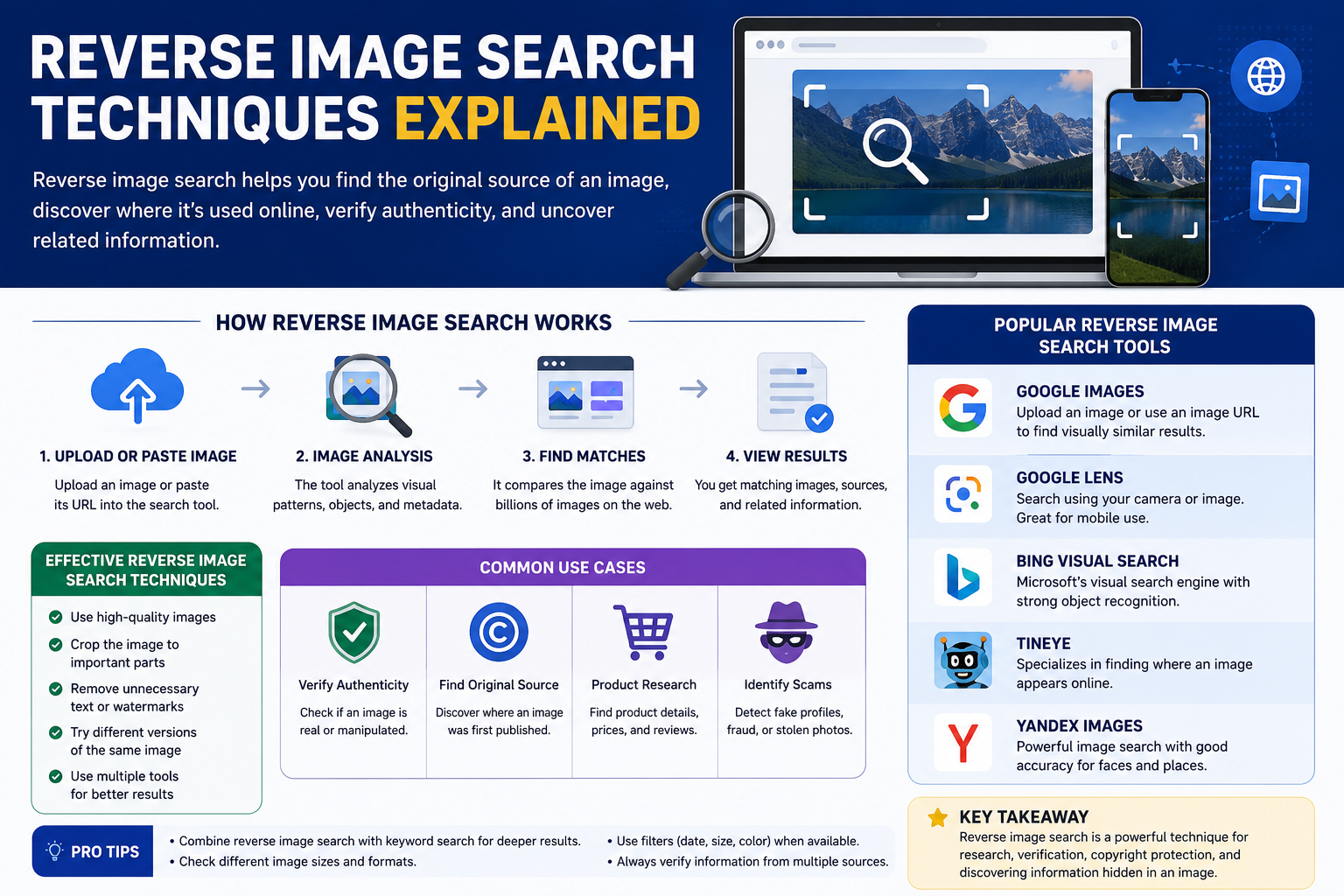
In an era when images circulate faster than facts and AI-generated visuals blur the line between authentic and synthetic, the ability to trace an image’s origins or locate similar content has shifted from niche curiosity to practical necessity. Journalists verify viral photographs, e-commerce professionals identify product sources, researchers track visual misinformation, and individuals seek context for unfamiliar images. Reverse image search provides a direct path to that information by treating a picture as the query itself.
Quick Answer: Reverse image search allows users to submit an image via upload or URL to find identical, near-identical, or semantically similar images across the web. The underlying techniques range from fast perceptual hashing, which excels at detecting minor edits, to deep neural network embeddings that capture higher-level visual meaning and handle greater transformations. No single method or commercial tool delivers perfect results in every case; the most reliable outcomes come from a deliberate, multi-engine workflow combined with critical evaluation of the returned context, metadata, and image provenance.
What Exactly Is Reverse Image Search?

Reverse image search, also known as reverse image lookup or content-based image retrieval (CBIR) when discussed in technical literature, inverts the conventional search paradigm. Instead of entering keywords or phrases, the user provides an image as the starting point. The system then analyzes the visual content colors, shapes, textures, objects, spatial relationships, and, in advanced implementations, semantic concepts and returns matching or related images along with associated web pages, publication dates, and contextual information where available.
Traditional text-based search relies on metadata, captions, alt text, or surrounding page content. Reverse image search bypasses much of that layer by examining the pixels and derived features directly. This makes it particularly valuable when textual information is absent, inaccurate, or deliberately misleading common situations with screenshots, memes, repurposed stock photography, or images stripped of context on social platforms.
The approach has matured considerably since its early commercial implementations. TinEye launched in 2008 as one of the first dedicated reverse image search engines, focusing on exact and near-exact matches through digital fingerprinting. Google introduced its “Search by Image” feature in 2011 and later integrated capabilities into Google Lens. Other major players followed, including Bing Visual Search and Yandex Images. By the mid-2020s, most general-purpose engines incorporated machine learning, while specialized services emerged for faces, products, or large-scale monitoring.
Practical applications span several domains relevant to U.S. readers. Newsrooms use reverse image search to authenticate user-submitted photos or trace the origin of contested visuals. Intellectual property holders monitor unauthorized use of their imagery. Retailers and manufacturers identify counterfeit listings or locate original product photography. Genealogists and archivists attempt to date or contextualize historical photographs. Individuals concerned about privacy or misinformation can check whether a personal photo has been repurposed elsewhere. In each case, the technique serves verification and discovery rather than guaranteeing absolute truth; results always require human judgment.
Core Components and How It Works
A reverse image search system follows a consistent pipeline, though the specific algorithms and infrastructure differ between free consumer tools and enterprise-grade platforms. Understanding the main stages helps users interpret results and choose appropriate tools.
Image acquisition and preprocessing. The process begins when a user uploads a file or supplies a URL. Systems typically normalize the image: resizing to a standard dimension or aspect ratio, converting to grayscale or a consistent color space, and applying light noise reduction or sharpening. These steps reduce computational load and improve consistency across varied inputs. Heavy compression artifacts or very low-resolution originals can degrade performance at this stage.
Feature extraction. This is the technical heart of the system and where the major methodological divide lies.
- Perceptual hashing (also called image fingerprinting) generates a compact, fixed-length string or bit vector that represents the image’s visual essence rather than its exact binary data. Common variants include average hash (aHash), difference hash (dHash), and perceptual hash (pHash). The algorithms typically reduce the image to a small grid (for example, 8×8 or 32×32), apply transformations such as discrete cosine transform in some implementations, and produce a hash. Minor edits resizing, moderate compression, slight cropping, or brightness adjustments usually leave the hash similar enough that a distance metric (commonly normalized Hamming distance) can still identify a match. These methods are fast and storage-efficient but struggle with significant geometric changes, heavy editing, or semantically similar but visually distinct images.
- Deep learning embeddings (or feature vectors) extract richer representations using convolutional neural networks or vision transformers. Models such as variants of ResNet, EfficientNet, or CLIP produce high-dimensional vectors (often hundreds or thousands of dimensions) that encode hierarchical information: edges and textures in early layers, object parts in middle layers, and semantic concepts in later layers. Because these embeddings capture meaning rather than pixel-level patterns, they handle rotation, viewpoint changes, partial occlusion, and stylistic variations more gracefully. Academic and industry benchmarks consistently show CNN-based approaches outperforming perceptual hashes on near-duplicate and transformed-image tasks, though at higher computational and memory cost.
Indexing and storage. Once features are extracted, they must be stored for rapid comparison against millions or billions of indexed images. Perceptual hashes lend themselves to simple inverted indexes or locality-sensitive hashing. Embeddings require approximate nearest neighbor (ANN) search structures libraries such as FAISS (developed by Meta) or Annoy enable sub-linear search times even at large scale. Commercial engines maintain massive, continuously updated indexes of publicly crawlable web images; coverage is never complete, particularly for images behind paywalls, on small personal sites, or recently uploaded content.
Similarity computation and ranking. The system calculates a similarity score between the query feature and each candidate in the index. For hashes this is usually Hamming distance; for embeddings it is often cosine similarity or Euclidean distance. Results are ranked and filtered by a relevance threshold. Many systems then apply additional signals page authority, recency, image resolution, or user engagement to improve the displayed order. Some also cluster near-duplicates or surface “best” versions (highest resolution, earliest publication).
Result presentation and context. Modern interfaces return not only matching images but also the web pages where they appear, approximate publication dates when detectable, and visually similar (but not identical) images. This contextual layer is often as valuable as the match itself for verification work.
Hybrid systems combine both hashing and embedding approaches, using fast hash-based filtering to narrow candidates before applying more expensive embedding comparisons. Mobile and browser-based tools may perform lightweight on-device analysis before sending data to servers.
Claims of Accuracy and Real-World Effectiveness
Vendors and independent testers frequently publish performance figures, yet these claims require careful interpretation. “Accuracy” in reverse image search is not a single metric; it depends on whether the goal is exact-match detection, near-duplicate identification, or semantic similarity, as well as the degree of image transformation and the domain (general objects, faces, products, or landmarks).
Independent comparisons conducted in 2025–2026 illustrate the variation. Tests focused on face identification consistently found specialized services outperforming general engines. One evaluation reported PimEyes achieving 85–95% accuracy on face-matching tasks where Google and TinEye hovered in the 25–40% range. Yandex Images performed notably better than Google on faces in several head-to-head assessments, with reported rates around 65–75%. For object and product recognition, Google Lens and Bing Visual Search tended to lead due to their vast indexes and integration with shopping and knowledge-graph data.
Academic evaluations reinforce the technical trade-off. A controlled study comparing perceptual hashing variants (aHash, dHash, pHash, wHash) against a CNN embedding model found that hashing methods delivered strong results for exact or very lightly modified duplicates at low computational cost but degraded sharply under rotation, cropping, or other geometric changes. The CNN approach showed markedly higher mean average precision across near-duplicate and transformed-image test sets, confirming greater robustness at the expense of speed and resource requirements.
These findings align with broader patterns: perceptual hashing remains efficient for large-scale deduplication and copyright monitoring where images are expected to be near-identical. Embedding-based systems shine when users need to locate conceptually related imagery or contend with edited or lower-quality inputs. No publicly documented system claims or demonstrates 100% recall across the open web; index coverage gaps, adversarial edits, and AI-generated content that has not yet been widely indexed all impose hard limits.
Commercial marketing language sometimes emphasizes headline accuracy percentages without disclosing test conditions, dataset composition, or failure modes. Responsible users therefore treat published figures as directional indicators rather than guarantees and validate important results through multiple tools and supplementary research.
Selecting and Using Reverse Image Search Tools
Effective practice in 2026 favors a layered workflow rather than reliance on any single platform.
Begin with free, high-coverage general engines. Google Lens (accessible via Google Images or the Lens app) offers the largest index for most object, landmark, and product queries. TinEye excels at tracing exact or near-exact image history and is particularly useful for copyright or provenance questions. Bing Visual Search provides a strong complementary view, especially for shopping-related imagery. Yandex Images often surfaces results from regions or sites less comprehensively covered by Western engines and performs better on certain face-related queries.
For face-centric or people-search needs, specialized paid services such as PimEyes or newer platforms combining facial recognition with social-media aggregation deliver higher hit rates, though they raise distinct privacy and consent considerations. Niche tools focused on duplicate detection or stock-image monitoring serve professional content creators and rights holders.
Practical technique tips improve outcomes across tools:
- Start with the highest-quality, least-compressed version of the image available.
- Crop tightly to the primary subject when background clutter or multiple elements are present.
- Test both upload and URL methods; some engines handle one better than the other.
- Run the same image through two or three different engines and compare results.
- Examine not only exact matches but also the “visually similar” suggestions, which can reveal context or earlier versions.
- Cross-reference any dates or source claims against the linked pages and archive services.
Browser extensions and mobile apps streamline the process for frequent users. For higher-volume or automated needs, some platforms offer APIs, though access terms and pricing vary.
Limitations and Challenges
Reverse image search is powerful yet imperfect. Performance drops when images have been heavily manipulated, heavily compressed, or generated by AI models whose outputs are not yet widely indexed. Very recent or obscure images may return no results simply because they have not been crawled. False positives occur when visually similar but unrelated images (common color palettes, generic scenes) rank highly. False negatives arise when a legitimate match exists outside the engine’s index or when aggressive transformations have altered key features beyond recognition.
Technical limitations intersect with societal ones. Facial recognition capabilities, while improved, carry well-documented risks of bias and error, particularly across demographic groups an issue broader than any single reverse-image tool but relevant when people-search features are used. Index construction itself raises questions about whose images are crawled and how consent is handled at web scale.
Privacy, Legal, and Ethical Considerations
Using reverse image search responsibly requires awareness of both capabilities and boundaries. Tracing a publicly posted image for verification or copyright enforcement generally falls within accepted practice. Using the same tools to identify private individuals without legitimate purpose, or to enable harassment, crosses into problematic territory. Several U.S. states have enacted or are considering biometric privacy statutes that affect facial recognition technologies; organizations employing these tools at scale should consult legal counsel regarding compliance.
Copyright holders have successfully used reverse image search to identify infringements and support DMCA notices. At the same time, fair-use defenses and transformative contexts remain relevant; the existence of a match does not automatically determine legality. Emerging standards for image provenance, such as C2PA metadata, may eventually provide cryptographic signals of origin and editing history that complement reverse-image techniques.
Users should also consider the data practices of the services they query. Free general engines monetize through advertising and data collection; specialized face-search platforms often operate on subscription models with explicit data-retention policies. Reading terms of service and privacy statements is prudent before submitting sensitive imagery.
Practical Recommendations and Future Outlook
For most U.S. users journalists, researchers, marketers, or concerned individuals a pragmatic starting protocol is straightforward: run the image through Google Lens, supplement with TinEye for provenance, add Yandex or Bing for additional coverage, and escalate to a paid face or monitoring service only when the stakes justify it. Document the tools used and key findings when results will inform public or professional decisions. Treat every match as a lead requiring verification rather than conclusive proof.
Looking ahead, several trends are likely to shape the field. Continued advances in multimodal models will improve semantic understanding and the ability to handle mixed text-and-image queries. Better integration of provenance standards may help distinguish authentic from synthetic imagery. On-device and privacy-preserving computation could reduce the need to upload sensitive images to third-party servers. At the same time, the proliferation of generative AI will increase both the volume of synthetic content that needs verification and the sophistication of adversarial edits designed to evade detection.
Conclusion
Reverse image search represents a mature application of computer vision that has moved from research curiosity to everyday utility. Its core techniques perceptual hashing for speed and efficiency on near-identical content, and neural embeddings for robustness and semantic depth each carry distinct strengths and limitations. Independent evaluations confirm that hybrid, multi-tool approaches currently deliver the best practical results, while also underscoring that accuracy claims must be evaluated against specific use cases and test conditions.
As visual content continues to dominate online discourse, proficiency with these techniques contributes to digital literacy and verification capacity. Used thoughtfully, with attention to context, limitations, and ethical boundaries, reverse image search serves as a valuable instrument for clarity in an increasingly image-saturated information environment. The technology will keep evolving; the need for critical human oversight will remain constant.
FAQs
How do I perform a reverse image search?
Go to images.google.com and click the camera icon to upload an image or paste a URL. On mobile, use Google Lens. For more results, also try TinEye and Yandex Images with the same photo.
What is the difference between perceptual hashing and AI embeddings?
Perceptual hashing creates fast digital fingerprints effective for near-identical images with minor edits. AI embeddings from neural networks capture deeper visual meaning and handle greater changes such as rotation or heavy editing, though they require more computing power.
Which tools work best for identifying people?
General engines like Google Lens have limited facial matching due to privacy settings. Specialized services such as PimEyes and Yandex typically deliver stronger results for faces, according to 2026 tool comparisons.
Can reverse image search detect edited or AI-generated images?
It can sometimes reveal earlier versions or source inconsistencies that suggest editing. However, it is not designed for deepfake or AI-content detection; dedicated forensic tools and provenance standards are more reliable for that purpose.
Why might a search return no useful results?
The image may be too new, heavily altered, or absent from an engine’s index. Try multiple tools, crop to the main subject, or search for distinctive elements separately.
Are there privacy risks with these tools?
Yes, especially with face-recognition services that can identify individuals. General engines carry lower risk for public images. Always review privacy policies and avoid uploading sensitive photos without a clear, legitimate reason.
How will AI change reverse image search?
Future AI advances are expected to improve semantic understanding, better detect synthetic content through provenance tracking, and enable more on-device processing for greater privacy and speed.